
Flashcard · Neonatal Jaundice
What is the Kasai portoenterostomy, and what determines its success?
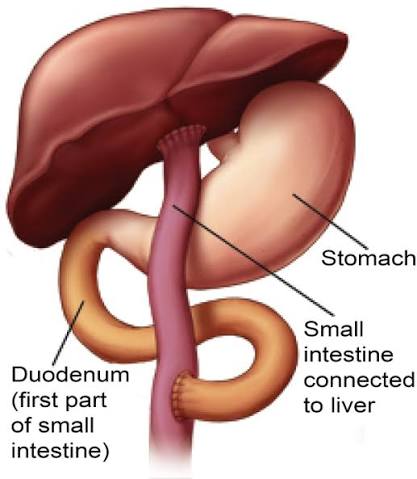
Answer
The Kasai portoenterostomy excises the fibrous biliary remnant at the porta hepatis and constructs a Roux-en-Y portoenterostomy, so bile drains through tiny residual ductules. Success depends most on early surgery (ideally before ~3 months), the type of atresia, surgical expertise, and pre-existing liver damage; overall success is about 60%, and it is a bridge to transplant.
Clinical relevance. Knowing that the Kasai's success hinges on early timing reinforces the urgency of diagnosing biliary atresia.
More Detail
Kasai portoenterostomy
The Kasai procedure is the first-line surgical treatment for biliary atresia, aiming to restore bile drainage.
The procedure
- The fibrous biliary remnant is dissected off the porta hepatis (between the hepatic arteries and portal vein branches).
- A Roux-en-Y portoenterostomy is constructed, so bile drains through tiny residual hepatic ductules at the porta.
Factors determining success
- Timing: best done early (before about 3 months of age).
- Type/nature of the atresia; surgical expertise; pre-existing liver damage; immediate post-operative care.
- Success judged by clearance of jaundice, normalising bilirubin/LFTs, good stool colour and weight gain.
Outcome
- Overall success about 60% even with timely surgery; a successful Kasai = native liver survival over 2 years.
- The disease is progressive - Kasai is a bridge to liver transplantation.
Practise every Gastroenterology and GI Surgery topic
This is a free sample. Sign up for the full bank of flashcards and exam-style questions on a spaced-repetition schedule, with 20 free stars a day.
More on Neonatal Jaundice
- FlashcardWhat is neonatal jaundice, and how common is it?
- FlashcardWhy are newborns prone to jaundice (the basis of physiological jaundice)?
- SBA questionA baby develops visible jaundice within the first 24 hours of life. How should this be regarded?
- True/False MCQRegarding physiological neonatal jaundice, the following statements are TRUE: