
Single Best Answer (SBA) · Gynaecological Laparoscopy
A woman with a previous midline laparotomy for bowel surgery is to undergo laparoscopy. Considering her history, which complication is she at particularly increased risk of during umbilical entry, and how is the risk reduced?
Show answer and explanation
Answer: D. Bowel injury from adhesions, reduced by using an alternative (e.g. open or left upper quadrant) entry technique
Entry-related bowel injury in previous abdominal surgery
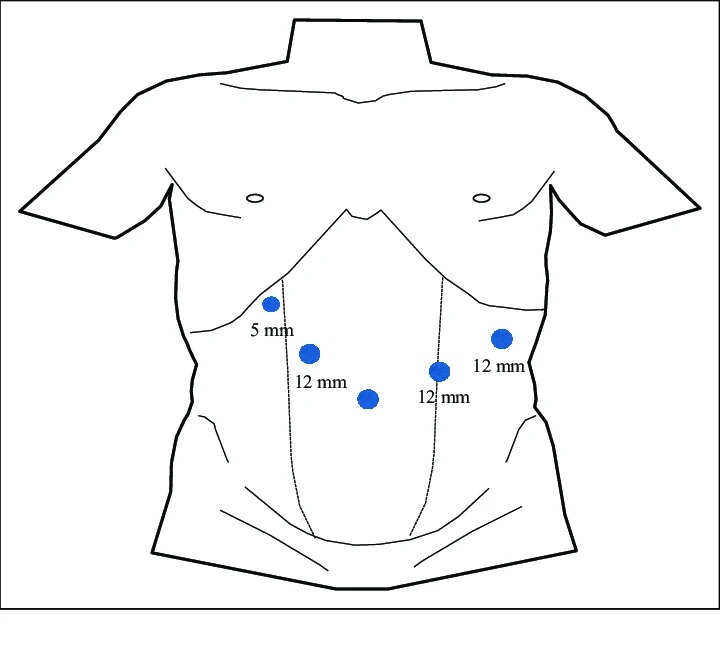
Laparoscopy begins with creating a pneumoperitoneum (usually a Veress needle at the umbilicus) and inserting the primary trocar. A previous laparotomy predisposes to adhesions between bowel and the anterior abdominal wall.
Why bowel injury
- Adhered bowel beneath the umbilicus can be perforated during blind entry - bowel injury is especially associated with previous laparotomy.
- Risk is reduced by an alternative entry - e.g. an open (Hasson) technique or entry away from the scar (such as the left upper quadrant / Palmer's point).
Other entry complications
Vascular injury (major vessels), bladder injury, and (later in dissection) ureteric injury - the latter especially in endometriosis and hysterectomy.
Why the others are wrong
Ureteric and bladder injuries are not the principal entry risk from prior laparotomy; gas embolism is from CO2 (nitrogen is not used and would not solve adhesion risk); vaginal laceration is unrelated to abdominal entry.
Practise every Obstetrics & Gynaecology topic
This is a free sample. Sign up for the full bank of flashcards and exam-style questions on a spaced-repetition schedule, with 20 free stars a day.