
Flashcard · Antepartum Haemorrhage
How is placenta praevia defined and classified?
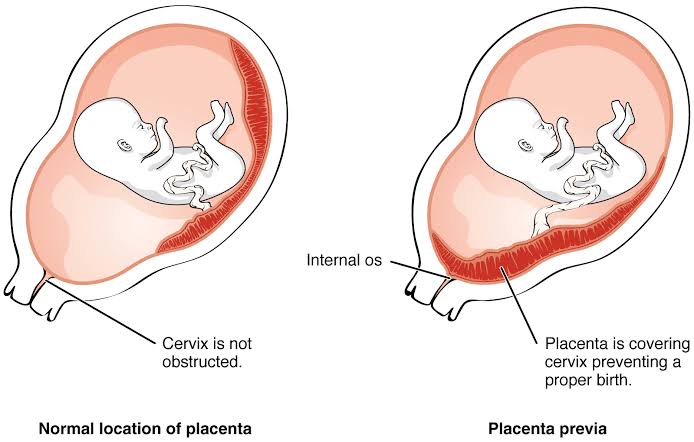
Answer
Placenta praevia is a placenta implanted in the lower uterine segment, generally defined after 28 weeks (most low placentas 'migrate' up by 30-32 weeks as the lower segment forms).
- Major praevia - placenta covers the internal os
- Minor / low-lying - placental edge within 2 cm of the os but not covering it
- >2 cm from the os - not praevia
Clinical relevance. The major/minor classification determines the mode and timing of delivery and the accreta risk.
More Detail
Definition and classification of placenta praevia
Placenta praevia is implantation in the lower segment, and the degree determines management.
Definition and migration
- Placenta in the lower uterine segment; generally defined after 28 weeks.
- Most low placentas migrate up around 30-32 weeks as the lower segment forms and lengthens - so a low placenta at the mid-trimester scan is rechecked later.
Classification
- Major praevia - the placenta covers the internal os.
- Minor / low-lying placenta - the placental edge is within 2 cm of the internal os but does not cover it.
- More than 2 cm from the os - not placenta praevia.
Significance
The classification determines mode and timing of delivery (major praevia and bleeding minor praevia need caesarean), and warns of morbidly adherent placenta (accreta), particularly with a previous caesarean.
Practise every Obstetrics & Gynaecology topic
This is a free sample. Sign up for the full bank of flashcards and exam-style questions on a spaced-repetition schedule, with 20 free stars a day.
More on Antepartum Haemorrhage
- True/False MCQRegarding the distinction between placenta praevia and abruption, which of the following statements are TRUE?
- SBA questionA 24-year-old with two previous caesareans has placenta praevia with accreta and develops severe uncontrollable…
- FlashcardWhat is placental abruption and what are its clinical features?