
Single Best Answer (SBA) · Surgical (Obstructive) Jaundice
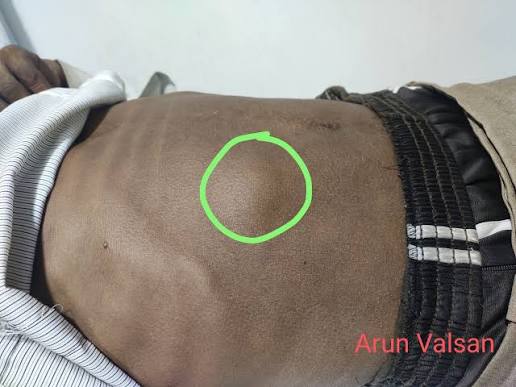
A 68-year-old man presents with progressive painless jaundice, weight loss and pruritus over one month. On examination he is deeply jaundiced and a non-tender, globular mass is palpable in the right upper quadrant. Applying Courvoisier's law, what does the palpable gallbladder in this jaundiced patient suggest?
Show answer and explanation
Answer: C. Gallstones are an unlikely cause and malignancy should be suspected
Courvoisier's law and painless obstructive jaundice
Courvoisier's law states that in the presence of jaundice, a palpable, non-tender gallbladder is unlikely to be due to stones. The reasoning is that chronic gallstone disease produces a fibrosed, shrunken gallbladder that cannot distend, whereas a gallbladder distended by back-pressure usually reflects a more distal malignant obstruction (classically carcinoma of the head of the pancreas or a periampullary tumour).
Why this points to malignancy
- Painless, progressive jaundice with weight loss in an elderly patient is the classic picture of malignant biliary obstruction.
- A distensible (previously normal) gallbladder enlarges as pressure rises behind a slowly obstructing tumour.
Benign vs malignant causes of obstructive jaundice
| Malignant | Benign |
|---|---|
| Carcinoma head of pancreas | Choledocholithiasis (CBD stones) |
| Periampullary carcinoma | Benign biliary stricture |
| Cholangiocarcinoma | Chronic pancreatitis |
| Gallbladder carcinoma | Primary sclerosing cholangitis |
| Porta hepatis nodal compression | Mirizzi syndrome |
Painful vs painless
- Stone disease: often painful, with biliary colic and intermittent/fluctuating jaundice.
- Malignancy: typically painless and progressive, with weight loss preceding (pancreatic/cholangio) or following (periampullary) the jaundice.
Practise every Gastroenterology and GI Surgery topic
This is a free sample. Sign up for the full bank of flashcards and exam-style questions on a spaced-repetition schedule, with 20 free stars a day.