
Flashcard · Surgical (Obstructive) Jaundice
What is the classic clinical tetrad of obstructive (post-hepatic) jaundice?
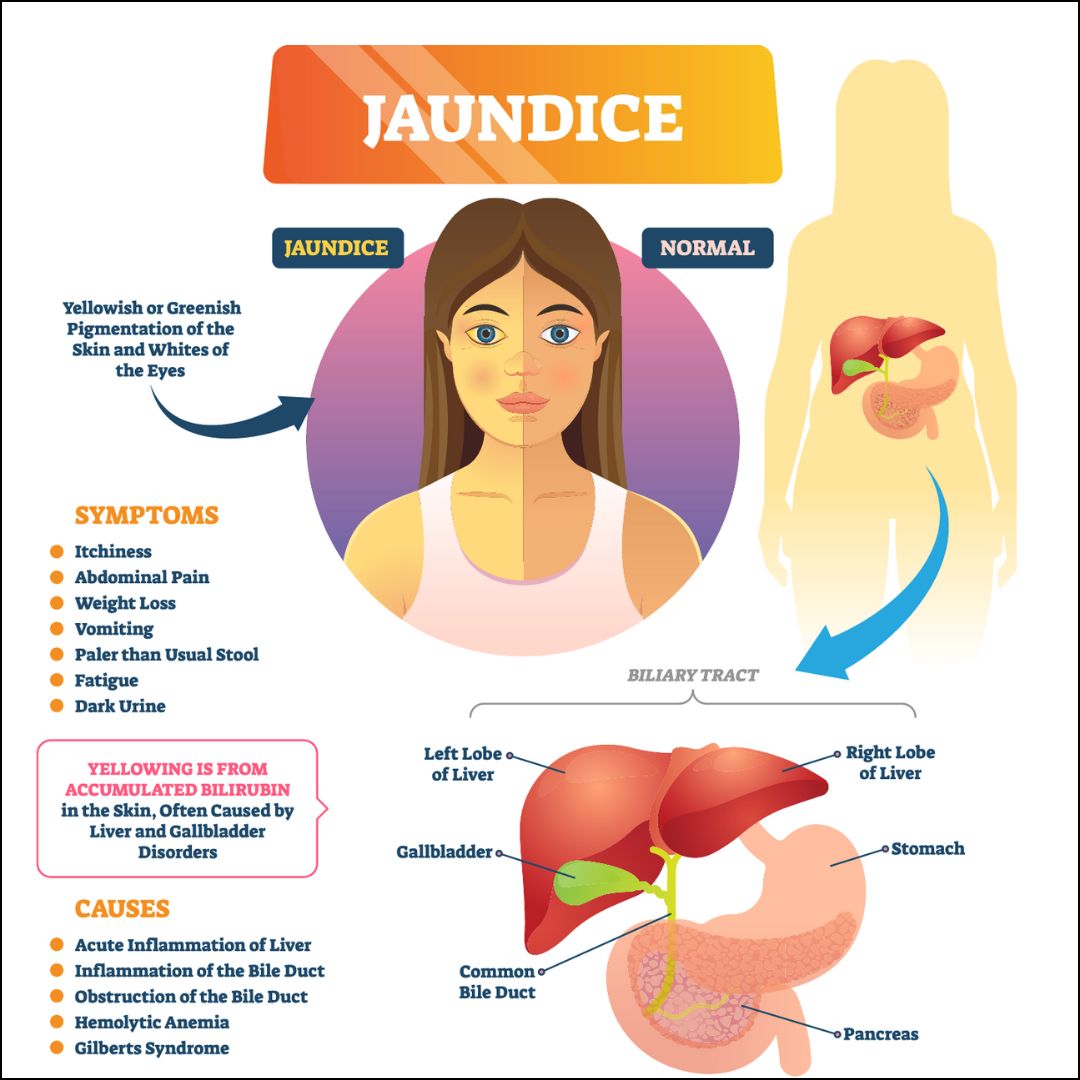
Answer
Jaundice, dark urine, pale stools, and pruritus. Conjugated bilirubin refluxes into blood and is excreted renally (dark urine), while its absence from the gut causes pale stools, and retained bile salts cause itch.
Clinical relevance. The tetrad rapidly identifies an obstructive pattern and directs imaging of the biliary tree.
More Detail
Obstructive jaundice
Obstructive, or post-hepatic, jaundice arises when conjugated bilirubin cannot reach the gut because of obstruction in the intrahepatic or extrahepatic biliary tree. The clinical picture follows directly from where the bilirubin and bile salts go instead.
The cardinal features
- Deep jaundice: conjugated bilirubin accumulates in blood.
- Dark urine: water-soluble conjugated bilirubin is filtered and excreted in urine; urinary urobilinogen is absent because no bilirubin reaches the gut to be converted.
- Pale (clay) stools / steatorrhoea: no bile pigment or bile salts reach the gut, so stool loses colour and fat is malabsorbed.
- Pruritus: retained bile salts deposit in skin.
Intrahepatic vs extrahepatic causes
- Intrahepatic cholestasis: primary biliary cholangitis, primary sclerosing cholangitis, biliary cirrhosis.
- Extrahepatic obstruction: gallstones, carcinoma of the pancreatic head, cholangiocarcinoma, strictures.
Practise every Gastrointestinal Surgery topic
This is a free sample. Sign up for the full bank of flashcards and exam-style questions on a spaced-repetition schedule, with 20 free stars a day.