
True/False MCQ · Twin and Higher-Order Pregnancy
Concerning twin-to-twin transfusion syndrome (TTTS), the following statements are correct:
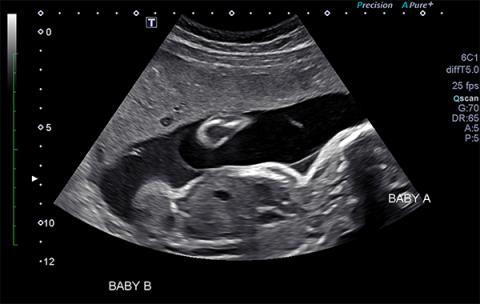
- AIt is due to placental vascular anastomoses in monochorionic twins
- BIt occurs in dichorionic diamniotic pregnancies
- CThe donor twin tends to have oligohydramnios and the recipient polyhydramnios
- DSevere TTTS has an excellent prognosis without treatment
- EFetoscopic laser ablation of anastomoses is a treatment option
Show answers and explanation
- A. True
- B. False: TTTS occurs in monochorionic (shared placenta) pregnancies, not dichorionic diamniotic.
- C. True
- D. False: Severe TTTS has a poor prognosis (perinatal death >80%) without treatment, not an excellent one.
- E. True
TTTS facts
- Caused by placental vascular anastomoses in monochorionic (not dichorionic) twins.
- Donor: hypovolaemia, anaemia, oligohydramnios, stuck twin, IUGR. Recipient: hypervolaemia, polyhydramnios, cardiac failure, hydrops.
- Severe TTTS (stage 2 or above) has a perinatal death rate >80% without treatment.
- Treatment: fetoscopic laser ablation of anastomoses (or amnioreduction; selective fetocide).
Why A is true
TTTS is due to anastomoses in monochorionic twins.
Why B is false
TTTS occurs in monochorionic, not dichorionic diamniotic, pregnancies.
Why C is true
Donor oligohydramnios, recipient polyhydramnios.
Why D is false
Severe TTTS has a poor prognosis (perinatal death >80%) without treatment.
Why E is true
Fetoscopic laser ablation is a treatment.
Practise every Obstetrics & Gynaecology topic
This is a free sample. Sign up for the full bank of flashcards and exam-style questions on a spaced-repetition schedule, with 20 free stars a day.
More on Twin and Higher-Order Pregnancy
- FlashcardWhen and how is chorionicity determined?
- FlashcardWhy does chorionicity matter clinically in twin pregnancy?
- SBA questionWhich aspect of antenatal management is particularly important in a twin pregnancy?
- SBA questionWhich of the following is a recognised maternal complication of multiple pregnancy?